1985 Strat Refret

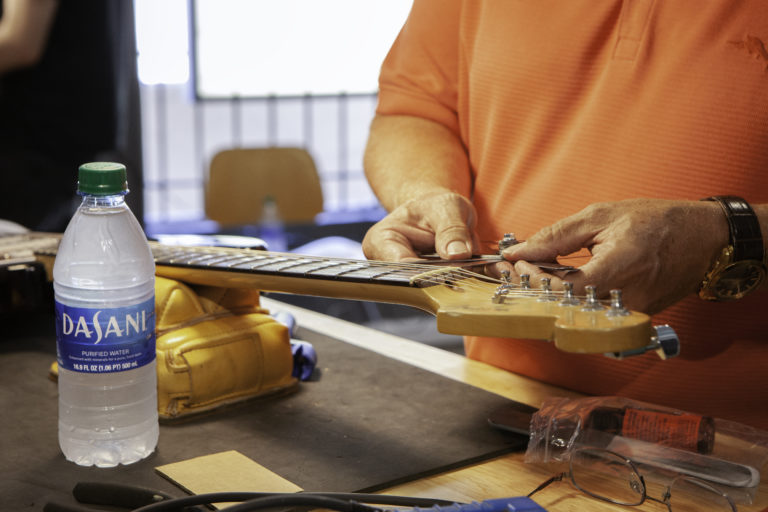
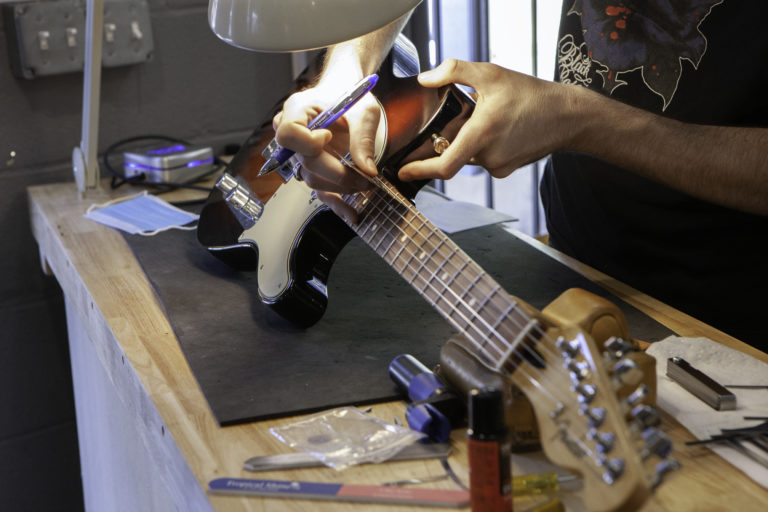
Here’s a 1985 “A series” Japanese Stratocaster on the fretting table.

Although I had leveled and recrowned this instrument a few months prior, the owner wanted higher frets due to his fingers slightly dragging in the middle of the board.

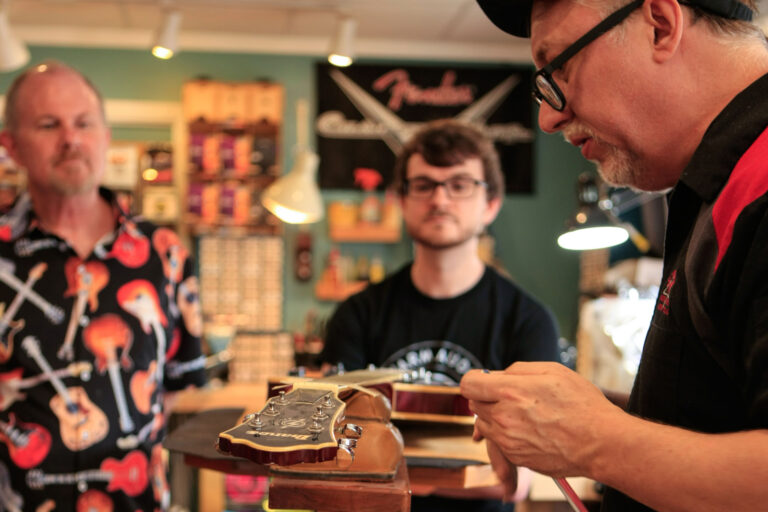
Here’s a nice picture of the aged headstock, along with the Japanese locking mechanism and the wooley mammoth tusk ivory saddle I had made for it.


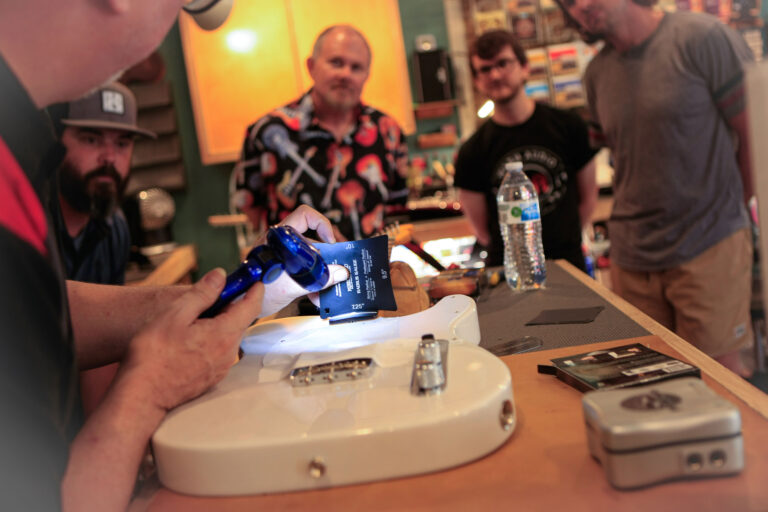
Here’s a close up of the groovy soldering iron used for heating up the frets prior to removal. This helps expand the wood and slightly brings the oils in the wood to the fret, acting as lubrication for removal. For ebony boards I also use a very liquid-like lemon oil.

Here I am starting to heat the fret, checking it by touch. Getting it to the point of almost too hot to touch is the just right amount.

These blunt nose pliers have been specially ground on the face to bite underneath the fret wire.

And here’s what the neck looks like with the frets removed.

Although this not exactly a necessary step, I keep them in the order they were removed. This can prove to be a good habit when matching bound fingerboards.

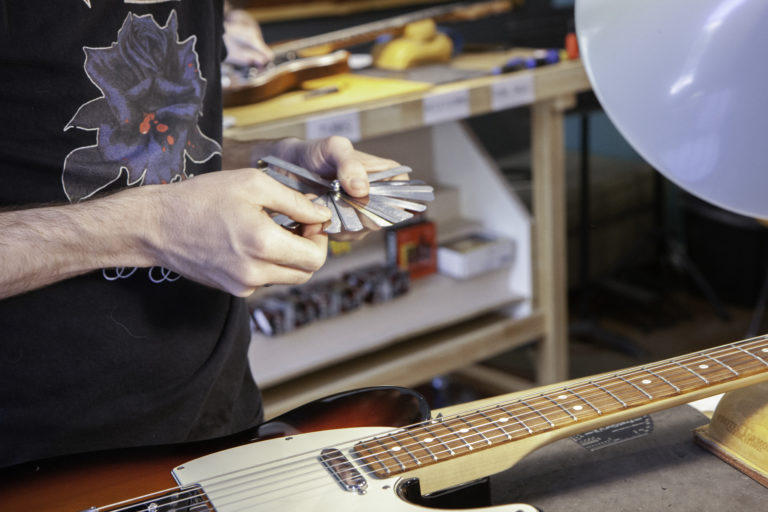
Once the neck is removed, its radius is checked at the nut,

…at the 4th fret,

…and at the end of the board.

Now fret wire is cut for each slot and saved in the order that they will be hammered in.

After each slot is cleared, each fret slot’s depth is checked with this handy little tool. This also reveals (by touch) how smooth the bottom of the slot is.

Each fret is slightly over bent to allow for the barb of the fret tang to grip to the side of the fret slot as it is flattened out.

Almost half way done hammering.


This section is done without the neck cradle.

The final fret is actually pressed and super glued in, to avoid breaking the end off.

A little off the sides please.

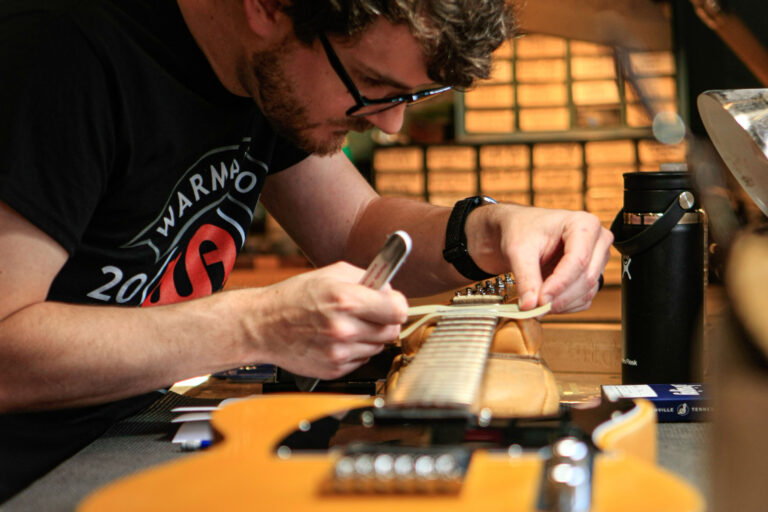
Fret ends can done with a beveling tool, but I prefer to do it by hand. It allows you to see what you’re doing, in addition to having control of the angle of the cut, plus it keeps your hand tool skills sharp.

This is a finer diamond file that I made. I actually have them in three different grits. They are also awesome for spot leveling frets.

Although not the best picture, these fret ends line up like soldiers.


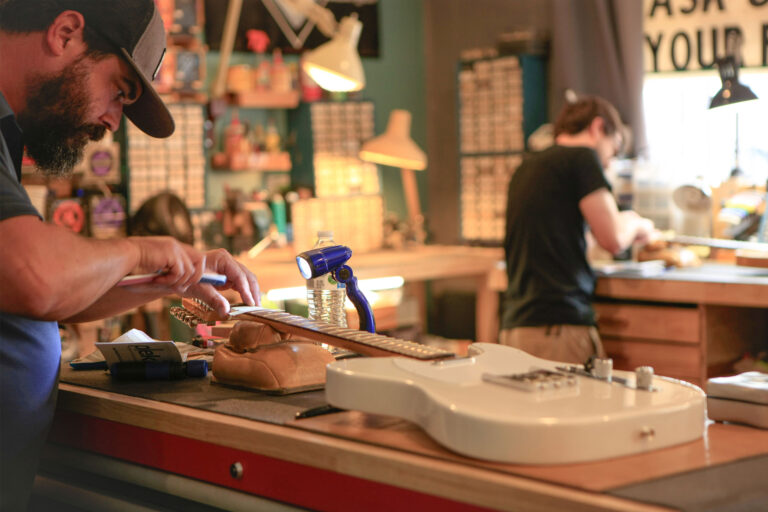
Now the frets are blued with a marker and leveled with a sanding beam. This tool is amazingly accurate. Companies that cut corners leave this and the following steps out.

The remaining blue marks indicate low spots. Sanding must continue to have accuracy. This is part of every (good) fret job.

This is how much a typical board gets sanded before crowning and fret ends are rounded smooth.

The board is taped off to the 8th fret and each fret is crowned (the tape can be used again on the other half of the fret board).

Fret ends are rounded gently with this specially ground Swiss made file. This thing is surgically precise. It’s killer.

Two shots of the finished fret work:


The nut has to fit just right. It captures a lot of the string’s energy and can make an audible difference in the sustain and tone of your instrument.


This Stewart MacDonald string spacing ruler is quite the time saver!

I use an array of nut files. My favorites are the Japanese made Hiroshima files. They are V-shaped and tapered nicely on the ends, allowing the final adjustments to be made without scarring the head of the instrument.

At this point, the guitar is strung and intonated with client’s strings gauge of choice. I usually stock D-addario 9.5’s, 10’s, 10.5’s, and 11’s. If you’ve never tried the half sizes but are looking for that nice happy medium, I’d suggest giving them a try.